




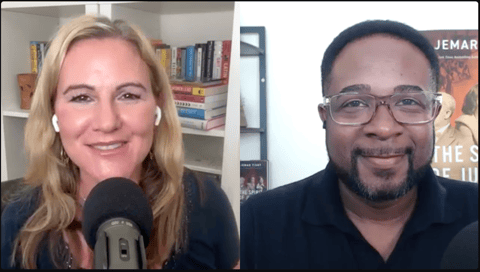


The Courage to Challenge Norms: One CPO's Journey to Better Company Culture with Tamesa Rogers

Feeling overwhelmed at work? This conversation will open your eyes to a whole new approach to company culture and leadership. Discover how to lead with clarity, fight for better workplace environments, and keep your humanity intact. Join us as we dive deep into the wisdom of Tamesa Rogers, a powerhouse in tech who spent 25 years building global teams and shifting company cultures. You'll be amazed by her insights and empowered to make a difference in your own workplace. Stay tuned for the exclusive deep dive with Tamesa on our Patreon community. This is the conversation you didn't know you needed.
In this episode, you will be able to:
Cultivate a Positive Company Culture: Discover the secrets to fostering an uplifting and motivating work environment that drives success.
Navigate Successful Career Pivots: Uncover the strategies to pivot your career path and achieve fulfillment in your professional life.
Lead Global Teams Effectively: Master the art of leading international teams to maximize productivity and collaboration across borders.
Foster Inclusive and Innovative Workplaces: Learn how to build a culture of inclusivity and innovation that fuels innovation and growth.
Overcome Toxic Workplace Environments: Explore effective ways to address and resolve toxic work environments for a happier and more productive team.


Feeling overwhelmed at work? This conversation will open your eyes to a whole new approach to company culture and leadership. Discover how to lead with clarity, fight for better workplace environments, and keep your humanity intact. Join us as we dive deep into the wisdom of Tamesa Rogers, a powerhouse in tech who spent 25 years building global teams and shifting company cultures. You'll be amazed by her insights and empowered to make a difference in your own workplace. Stay tuned for the exclusive deep dive with Tamesa on our Patreon community. This is the conversation you didn't know you needed.
In this episode, you will be able to:
- Cultivate a Positive Company Culture: Discover the secrets to fostering an uplifting and motivating work environment that drives success.
- Navigate Successful Career Pivots: Uncover the strategies to pivot your career path and achieve fulfillment in your professional life.
- Lead Global Teams Effectively: Master the art of leading international teams to maximize productivity and collaboration across borders.
- Foster Inclusive and Innovative Workplaces: Learn how to build a culture of inclusivity and innovation that fuels innovation and growth.
- Overcome Toxic Workplace Environments: Explore effective ways to address and resolve toxic work environments for a happier and more productive team.
My special guest is Tamesa Rogers
Tamesa Rogers is an experienced, results-oriented Chief People Officer with 25 years in the tech industry who is known for her deep expertise in organizational problem-solving, leading
growth, and culture shift while building global teams.
Most recently, Tamesa served as Chief People Officer at NETGEAR where she spent over 20
years with the company. As the company’s first in-house Human Resources leader, she built the
full HR organization from scratch, scaled the company from $300M to over $1B in revenue, and
led numerous cultural and organizational transformations. Before joining NETGEAR, Tamesa
served as an HR Manager at TriNet and HR Options.
Tamesa is active with How Women Lead, HR Executive Exchange and is a proud member of
Delta Sigma Theta Sorority, Inc. She holds an MS in Counseling from California State University, East Bay, and a BA in Communication Studies from the University of California, Santa Barbara.
Tamesa is an avid yet mediocre golfer, traveler, and reader of non-fiction and human capital
research.
The key moments in this episode are:
00:00:02 - Introduction to the podcast
00:03:37 - Tamesa's Journey in HR
00:10:25 - HR's Role in Supporting Employees
00:13:43 - Aligning HR Strategies with Business Goals
00:14:45 - Evolving Tech and Pushback
00:15:53 - Business Strategy and Work Environment
00:18:53 - Psychological Safety and Workplace Productivity
00:21:14 - Building Inclusive Teams
00:26:07 - Leading Across Cultures
00:28:59 - The Importance of Company Culture
00:30:01 - Aligning Culture with Business Goals
00:32:14 - Clarity and Change in the Workplace
00:33:33 - Leading with Courage and Values
00:37:17 - Bringing Humanity into Leadership
- Share this episode with five friends who need to hear it, and then send it to your manager to have a conversation about it.
- Send this episode to your friend who's quietly quitting and to that person you know could really change a room if they just believe they're enough and their voice mattered.
- Subscribe to the podcast, leave a review, and share this episode with someone you think might need to hear it.
- Start with a free trial to join us at patreon.com/AWorldofDifference to check out exclusive episodes with our guests.
- Head to www.betterhelp.com/difference to get 10% off your first month of online therapy with BetterHelp.
Know who you are and what your values are. If you are not comfortable doing that, it may be challenging for you to effectively do your job as a chief people officer. - Tamesa Rogers
Learn more about your ad choices. Visit megaphone.fm/adchoices
Follow the podcast at:
- https://www.youtube.com/@aworldofdifference
- https://www.aworldofdifferencepodcast.com
- https://www.linkedin.com/company/aworldofdifference/
- https://www.instagram.com/aworldof.difference/
Join our Difference Maker membership community for a ton of exclusive content for as little as $5/month. (The price of your a latte at your local coffee shop to enjoy a whole month of content.) Lori's Travel Tips are included as well as exclusive minisodes with our guests not available anywhere else. Join for deeper conversations and a little fun today at https://www.patreon.com/aworldofdifference
Keep making a difference wherever you are!
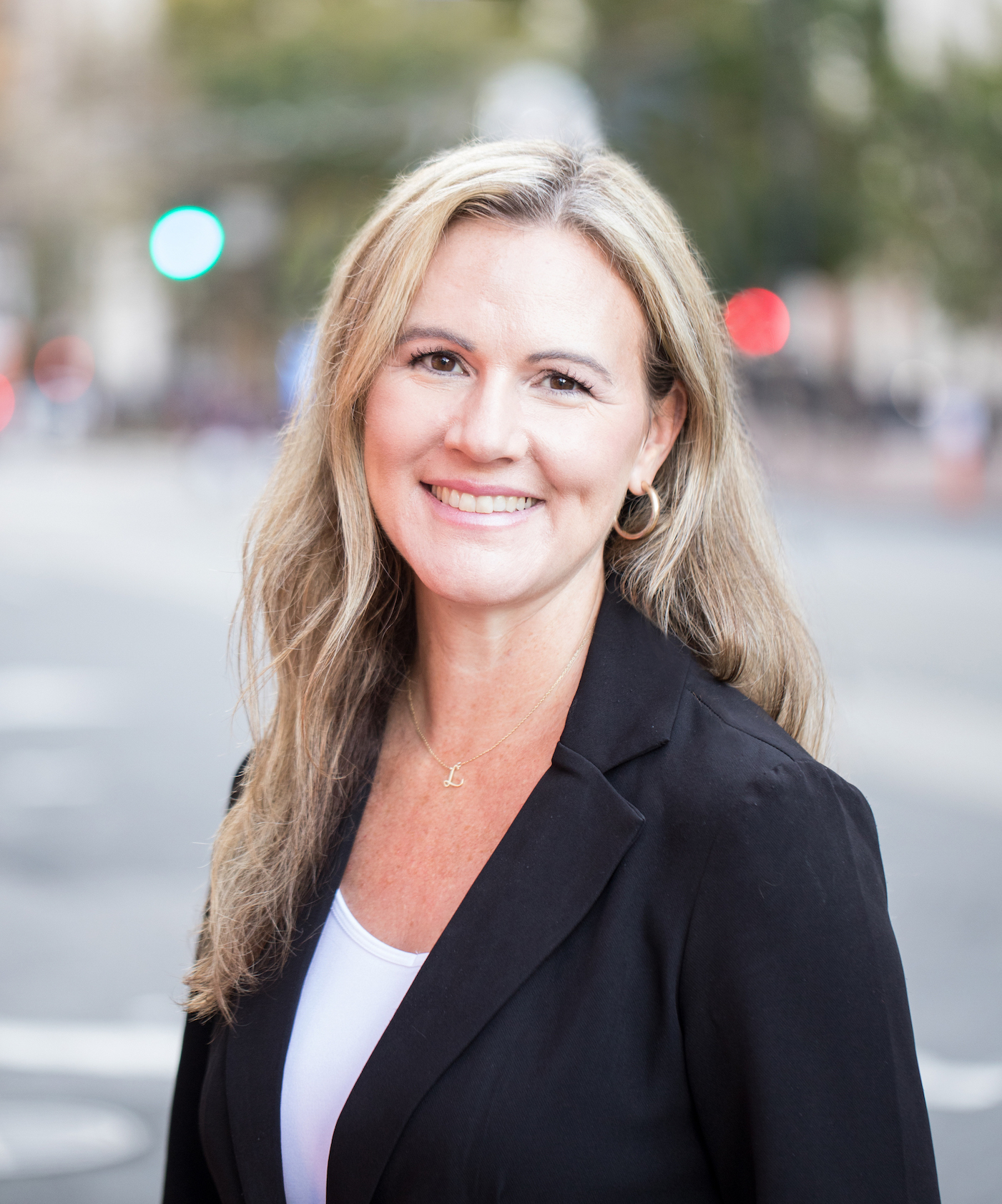
Lori Adams-Brown, Host & Executive Producer
A World of Difference Podcast
00:00:02
Welcome to the A World of Difference podcast. I'm Lori Adams Brown and this is a podcast for those who are different and want to make a difference. Today's episode is going to wake you up. I'm serious. If you've ever felt stuck in a toxic workplace or a workplace that didn't align with your values, felt undervalued in your career, or just like the culture around you at work just doesn't get you, this conversation is your moment.
00:00:26
Because Tamesa Rogers is not just a powerhouse in tech. She's a Chief People officer who spent 25 years building global teams, shifting company cultures and solving people problems most leaders run from. And she's doing it with heart, wisdom and a no BS mindset that we need more of in our world right now. This episode isn't about theory, although she knows plenty of that. She's a very educated and wise woman with a lot of experience and knowledge.
00:00:53
But it's about real leadership, real courage, real change, real taking that moment to speak up when it matters, at the right time, doing the right thing. So whether you're a leader, a parent, a difference maker, or someone trying to survive in the modern workplace, what you're about to hear could shift the way you show up for good. Let's go.
00:01:20
Hey friend, let's talk. If you've been feeling stuck, stuck, uninspired, or just plain over it in your career, this is your wake up call. It's time to stop waiting for that right moment and start making moves. Because no one is coming to rescue you. If you want to check out the Mastering the Career Pivot.
00:01:38
My brand new masterclass is designed to help you take control of your career pivot with confidence and land a job you actually love. This isn't some fluffy follow your dreams nonsense. This is real strategy to get unstuck and take action now. Right now, here's what you get. One hour of video training with me breaking down the exact steps you need to take.
00:01:59
One hour or maybe two hours depending on your process of self paced exercises to map out your career pivot. Plan a free career Pivot guide to walk you through the process. A clear, actionable roadmap so you can stop second guessing and start making moves. And if you want to go even deeper, you can grab the Pivot package. A powerful set of tools including a detailed workbook and three must have spreadsheets to track your job search, networking and applications like a pro.
00:02:25
And let me just say, if you're going out there expecting to just apply for a job, the first job and get it. Maybe you're one of those people and maybe you do. But if you're like most of the rest of us, you get a job based on people you know. And statistically speaking, that's true, as well as in my own lived experience and career journey. So networking is really a huge part of it, but a lot of us don't know how.
00:02:46
And so a spreadsheet where you can track that, break it down, figure out what to talk about. I have some sample interview questions, or you can do informational interviews. There's so much there in the pivot package that is part of my own journey that helped me when I did a career pivot several years ago. So here's the deal. This course will save you hours of frustration, second guessing, and aimless scrolling on job boards.
00:03:05
Not helpful. You don't have time to waste and your future is waiting. So let's get after it. Go to loriadamsbrown.com careerpivot and sign up for Mastering the Career Pivot today. Because your next chapter, it's not going to write itself.
00:03:19
Hi Tamisa. Welcome to a world of difference. You had such an impressive career in tech and I'd love for you to tell us a little bit about your journey and how you have found a passion for people leadership. Sure. So my journey actually started not in hr.
00:03:37
I was getting my master's in counseling. I wanted to be a child therapist. And what I found is in the second year when I was doing my internship and I was interning at a group home, it was really difficult for me to work with the young people during the day and then kind of shut it off and then live my life in the evenings and on the weekends. And so I found that I don't have that gift to be able to separate my professional and my personal life in that manner. Once I made that discovery, I'm like, what do I do?
00:04:12
Like, in a master's program? I will be graduating at the end of the year. And it just so happened that there was an HR consulting arm of that program. So I was able to switch over to HR consulting, where the focus was on organizational development, change management, but also using the skills that were being taught through the counseling program. And I was able to graduate and then focus on hr.
00:04:40
So that was kind of my introduction. Introduction to more strategic HR versus, you know, I had worked previously in an office environment where I knew how to do personnel files. I knew how to make sure people were paid a lot of the operational side. So I started working for a small PEO professional employer organization where there is payroll and benefits and HR consulting that is provided to companies who want to focus on their core competency. And the small company that I worked for had a focus on more industrial companies in the Midwest.
00:05:18
And this was in the early 2000s, well actually 2000. So this was during the dot com era. So I got recruited to work for Trinet. And I worked at TriNet for about three years and one of my clients ended up being Netgear. So I was on site at Netgear for a day, a week helping them with their US based HR org and they had gone public, decided that it was time for them to bring someone in house.
00:05:48
And so I was hired on as their very first HR employee. And so not only now was I responsible for the US HR function, which I was somewhat familiar with because I had been working for about a year and a half with that. I was now responsible for the global HR organization. And I found very quickly that there was really no coordination around that different. We weren't really sure how many employees employees were in each country.
00:06:16
Country managers were hiring and making changes. So it took a good 18 months to two years to just wrap my my arms around the global function. And then began the process of kind of building it out, so developing it into regions, coming up with how people will be paid performance management compensation. It really was building the org from the bottom up. And so from there there was the rapid growth portion.
00:06:47
There was a period of time where we were really involved in M and A. So there was a lot of M and A that was going on. Actually one of our acquisitions became wildly successful. We were able to spin it off an ipo, divestiture, IPO and spin of Arlo Technologies. Some board work, consulting with the board and then finally, well of course Covid leaving the office, coming back to the office.
00:07:13
And then finally the last bit of work that I did was working with the board to successfully complete the CEO succession plan. So co founder CEO was interested in retiring. So there was an external search that was happening. I was working on the internal part of it, trying to determine if there was an internal successor. And then ultimately an external successor was brought in for the onboarding of the new CEO.
00:07:39
We kind of just came to an agreement that he wanted to build his org, his executive team. It was good timing for me to kind of take an exit after 21 years. And then I took a well deserved break which ended at the end of last year because the beginning of this year is when I started kind of looking at New opportunities. So that's a very long short story about a very long period of time. It's so fascinating.
00:08:05
I find that in the HR part of business, we often get people who are, well, obviously very people oriented people. But the thing about HR is I feel like HR does everything. It's like the kitchen sink in some ways. So even in your story, your description is, in my experience with you, you're a very empathetic listener, you're a very people oriented person. And so, you know, knowing that you had gone into a helping profession and a desire to help children and even what made you pivot from that was that you, you cared so much that it was too much for you.
00:08:36
And so those are the kind of people that are so great in hr and to have somebody like that as a chro. But you're doing everything you're trying to figure out. I understand in the sense of how it's been in scaling organizations and how so much is having to be cleaned up by hr, figuring out how many employees are where. But you know, for you, every one of those people is a person. And so I love that you were bringing, you know, both head and heart into your role.
00:08:58
Right. And I think that those are the best kind of HR leaders, people like you, who understand the logistics but also bring your heart. How would you describe that part of who you are? And maybe is there a time in your childhood, I mean, you probably weren't asked, what do you want to be with when you grow up? And you probably didn't say chro, but maybe you did.
00:09:17
So like, how does that connect with who you are, were as a child and who you see yourself as today? Yeah. So I've always had a heart for people. I've always wanted to build relationships, build connections. I'm very much an introvert.
00:09:29
So when I go into new environments, I'm always looking for someone who looks to be uncomfortable because I know how that feels. And so I want to try to alleviate any discomfort that they may have. So I, I have, have always had a heart for people and I believe that there is a space to have compassion and to be human centered while still achieving business goals. I don't think it has to be a trade off. I think you can do both.
00:09:59
So I have always worked at trying to figure out the perfect intersection between business strategy and being human centered. I love that this is where I really connect with you. I mean, from the moment we met. We met at a How Women Lead event last year, get on Board week in Palo Alto, and we Were outside with this charcuterie table and wine and everything. And yeah, somehow we just, you know, connected.
00:10:25
And you made me feel more at ease in that situation because I didn't know a lot of people either. And so, and we both connected about being very people oriented in business. I really think that right now, what's going on in the world. I'm currently still working in a global business and tech company here based in Silicon Valley. And I've had a chance over the last month to visit two of our global sites again, both in Taiwan and the UK and here.
00:10:47
And there's a lot of stress going on in our US population because of geopolitical shifts. You know, there's tariffs, there's every five minutes it feels like there's something really huge and different. And that amount of change is also affecting, I think Taiwan because they're experiencing that in the sense that, you know, geopolitically it's like, well now is China going to invade Taiwan? And then in Europe it's well, is Europe going to be at war? And so all of these things, it's a global thing that people are feeling as people are listening and they're involved in business right now.
00:11:17
And maybe they are in HR or maybe they're, you know, in sales or they're in engineer. What would you say as to how HR can be a place and encouraging HR leaders to really help our employees feel more psychologically safe to express themselves when it's very stressful and change is constant. So I think just in general, human beings don't like change. And if you think about the amount of change that has occurred even in the last five years, it is phenomenal. So what I would encourage HR leaders, non HR leaders to do is really understand that as leaders we need to come with that mindset of how do we help our employees be successful, meet business goals, taking into consideration that there's a lot of change, there's a lot of uncertainty, there is tension, there is fear, there is some anger.
00:12:10
How do you acknowledge that, try to meet people where they are and still move them forward towards the business goals? Because ultimately we are in business to achieve business results. But like I was saying previously, I don't think that those are mutually exclusive. I think that acknowledging that there are people in the workforce who have feelings about life outside of work, if you take that into consideration, even just allow an opportunity for them to be heard, or if you are moving into, if you're making lots of changes over communication is critical. Asking people if they understand, asking people if There are any, like, am I missing something?
00:12:55
Here's the plan. What. What could I be missing? Because oftentimes, if you are a leader and you're not necessarily in the trenches, there may be blind spots. So allowing people to feel like they are contributing to the solution is also helpful.
00:13:13
HR can help by coming up with strategies and processes that can help align with the business goal. But if those processes and strategies are not aligned to business success, HR can only do so much. So I think the most important thing HR can do is hold up a mirror to the organization and say, like, these are our goals. Here's our engagement strategies. Here are our retention strategies.
00:13:43
Are there any gaps between what we have designed as strategies and what the output is? And if so, how do we address those gaps? I love that. Yeah, I mean, I think that I absolutely agree that what's good for employees, what's good for humans, is also good for business. Because we, you know, we do have a lot of conversations in the HR realm around employee engagement.
00:14:05
This is something that CEOs boards are very, you know, concerned about. Not just with what happened during the COVID pandemic, but we have a new generation, Gen Z entering the workforce. And the dynamics between, you know, what boomers, Gen X, millennials, and Gen Z expect out of the workplace is as different sometimes as a whole different culture coming in. And so being a good listener, just making the assumption as a leader that you do have areas of oversight, that you need people closer to the actual problem or situation to help you see it. Because when you lead at a high level, it's impossible for you to know everything.
00:14:45
So you need to create that psychological safety. And you've had 25 years in this, you've seen tech evolve in major ways. I wonder what is the most surprising or transformative change you feel like you've witnessed in your time? So surprising, I will say, in a not so great way, is this push to make everything like it was when we have experienced something new. I think there are lots of companies who really are trying their hardest to put toothpaste back into the tube.
00:15:16
And if you've ever tried it, and I have, it's very hard to do so, I would think. I think the most surprising change is that with all of, like, it really, we had a greenfield opportunity coming back from COVID to really decide how we want work to be done. Changing workflows, changing collaboration, changing processes, like, how do we want to continue moving forward? And lots of companies were like, okay, well, now there's no longer a pandemic risk. Let's just bring everybody back into the office.
00:15:53
Let's just do everything that we used to do. And I'm not advocating for a hybrid or a remote workforce. I think that ultimately the work needs to be done around how work best gets done based on business strategy. If a company is global and works across multiple time zones, the focus should be on collaboration. The focus should be on making sure that work can get done most effectively across time zones.
00:16:26
Where that happens, I mean, that's not for me to decide. But the focus should not be like we need to, we have all this real estate, we need to move back into an office and you're not fixing the actual problem, which is, are we making sure that we have the right strategy to get the best output so that work can get done, the best way to achieve business results. So I would say that was the most surprising to me is we moved from, what was it, the Great Resignation to now the Great Recession. And there was an immediate flip back to now that we as employers have the power, we're gonna force things to go back the way that it used to, as opposed to using it as an opportunity. Yeah, I think you're not alone.
00:17:12
And seeing that was a missed opportunity, I myself also resonate with that. And we've had some research done even within some very large global organizations where they've asked their team to research which is better remote hybrid, five days a week in the office. And the research became clear in this particular instance that hybrid was a better way. And yet the, even with the results of that research they'd done internally, the conclusion was, okay, we're going to do five days a week in the office. And so it's strange that research isn't actually playing into these.
00:17:42
Real estate seems to be the factor for a lot of decisions. And at that point, just call it what it is. Like don't say you want community or you want, you want collaboration. Because if everyone is in an office and they're still on the same Zoom call that they were on at home, that's not the answer. And even when deciding on a hybrid or a fully remote work environment, what processes are being changed to accommodate those decisions?
00:18:13
Because if everyone is still on zoom and everyone is still on email and then there's also slack going on and I spend my day on Zoom calls, but I like, I have then to do all these emails or if I'm in the office and I don't get to see anybody because I'm on Zoom calls and I'm addressing my emails Is that, is that the right decision? It's not just deciding where the work gets done. What changes are we making to make sure that those decisions provide the optimal output? Yeah, it's a, it's a higher level way of thinking, which I think for people like you who have like a. More of a psychology background, I have a sociology background.
00:18:53
I think people who have these lenses are looking at how to make this system better for humans as we get together. You know, so, like an example is, you know, we have a lot of these open workspaces here in Silicon Valley where, you know, you're on a zoom call, but then so is the person next to you. And so it's really kind of hard to like, hear what you're saying because they're talking and so. And then the, they have these phone booth type situations sometimes where you go sit in a booth, but those are small. And if you're stuck in one of those all day in an office, it feels sort of like you're a lab rat.
00:19:26
Like, is that, is that the best way for humans to spend a day? And isn't it better? They would be more productive and be happier and more engaged, because happier employees tend to be more engaged and innovative. So these are all like social psychological concepts that should be really huge factors in the decision making. Way more so than real estate prices.
00:19:46
Right, right. Because ultimately, if your business results are not, if you're not achieving the results that you're setting out to achieve, then you have to look at what those roadblocks are. I don't think we've gotten that far yet. I think we're still trying to push everyone back into an office. There's not, there hasn't been enough time to be able to look at a chart to see, hey, during COVID here was the productivity, or rather the business results.
00:20:12
After Covid and people being back in the office, this is the business result. And compare. I think we're still in a period of time where we're just making decisions and we'll see how it turns out. I agree. And I think to be fair, you know, CEOs, COOs, CHROs boards, these people are very busy here in Silicon Valley.
00:20:34
It's a busy life. If you're commuting to an office, it's a long commute usually. And so there's not a lot of time for deep thinking and hearing the research or reading the research around what is happening. And sometimes it's hard for people to even correlate that research. Like lack of engagement could be explained In a variety of ways.
00:20:52
And there's a variety of factors going on. And so that kind of deep thinking, taking the time, it feels a bit like a setup for the people making the decisions. And so, you know, for those of us who are trying to make a difference in the world through business, I think these important. These conversations are important. Taking time to listen to a podcast like this or going a little deeper on your commute hopefully will help help spur that conversation.
00:21:14
I think the more we get curious, right? Human beings are different. We're all unique. But there are some common things about how we operate as humans that we can draw from that scientific information. You know, you.
00:21:26
You know, we've mentioned how you were at Netgear, you were chief people officer at Netgear, and you've led through growth, you've led through global expansion and cultural shifts. What are some key lessons that you learned about building strong, inclusive teams at scale? The most important thing is building relationships, really trying to understand someone's perspective and then partnering with them to try to help them achieve those results. I think oftentimes we don't listen enough. We don't try to understand.
00:21:53
We are trying to force our perspective or we're trying to get our speaking time in. I think leading also requires being aware of what everyone is saying and then making the best time decision. By no means am I saying that all the time. There is time to get to a consensus and move forward. Sometimes you have a limited amount of time, but you want to gather as much data as you can in the time that you have to make an informed decision.
00:22:20
And that requires listening to people who are not you. I think listening to people who have different perspectives to challenge you, to make sure that you're on the right page. Understanding blind spots, understanding, okay, we make this decision. What are the consequences of those decisions and how do we. How do we address those.
00:22:42
Those consequences? So it's really just. It's all relationship building to me. Understanding. Well, first you have to understand what.
00:22:50
What problem you're solving for, and then building relationships and making sure that you have the best information that you have that that's available to make a decision. I couldn't agree more. In my key leadership program that I've developed and executed globally, and we have it in multiple languages. The foundational aspect of it is called listen to understand. We go through a lot of skills.
00:23:14
I have our people, everybody from our president to all our individual contributors, they get to practice the skills in real time. And I tell them, you know, to this day, I still don't have a PhD in listening. It's hard work. Listening is one of the hardest leadership skills you will have, but it's also a superpower because the leaders who listen well are the ones we want to promote. They're the ones that want to.
00:23:33
That are sought after because they are aware that they don't know everything and that they need to find the information. And that is truly a superpower in business. I wish more people saw the value of it and it wasn't such a radical thing to ask people to come learn how to listen. Because I think a lot of people think they're good listeners, and those are the ones that really need to be in the course. The most important part of listening to me is listening to what is not being said, paying attention to nonverbal communication.
00:24:05
It is easy to have a talk track. And there's so much more involved with listening than just the talk track. What is the body language like? Are they combative? Are they defensive?
00:24:20
Are they open? Do they seem to be hiding something? Like, there's all that that goes into listening. How you say something means that there's something that you're not saying. The meat of probably the message is not being said.
00:24:35
Part of. I guess my superpower of being an introvert is that I'm very observant, and so I'm always paying attention to what's being said, who's saying it, and then what's not being said, and even what's the response in the room? 100%. I actually already noticed that about you. And I love having introverts on my team for that reason, because I find that by and large, the world is made for extroverts in this culture.
00:25:00
Some cultures are more introverted, but this one we're both living in now is more extroverted oriented. And so bringing in introverts on the team really has. It's so important and giving them the psychological safety and, you know, even opportunity to just like, have a pause and not be filling the space all the time with words. One of the things that you're probably familiar with, but, you know, it's kind of shocking to some people. In my Listen to Understand course, we go through Dr.
00:25:26
Albert Mehrapian. He did this seminal study on listening and communication, and only 7% of our communication is words, which is shocking to a lot of people. But it's just like you said, 33% is like tone and inflection, and then 55% is our body language. And so that could be different across cultures where it comes to eye contact is more, you know, expected here in the west, but in Asian cultures, where I worked for 20 years, it was very different. So.
00:25:54
But body language, by and large, can. Is. Is something you don't want to miss because you're missing over half of how people communicate. This next question is, you know, many of our listeners do work in these global or multicultural environments. You're familiar with this because Netgear is the same.
00:26:07
And then Bay Area is like that, too. But what advice do you have for leading people across cultures with empathy and effectiveness? I would say first, educate yourself. When you are working across multiple cultures, take some time to try and understand what the norms in that culture you mentioned, in Asian cultures, eye contact might be uncomfortable. In addition, speaking truth to power might be uncomfortable.
00:26:35
So just because you are having a meeting and you ask, are there any questions, any concerns, any problems, and their silence, that does not mean that there aren't any questions, concerns, or comments. So just getting a general understanding about the different cultures, I, I think is important. And having an appreciation for the differences in cultures. I think if you lead with curiosity all the time, you can't go wrong. It's only when assumptions are made or stereotypes are followed that you run into problems.
00:27:10
Yes. Oh, that's such good advice. We often. Well, there's this book called the Culture Map. I talk about it a lot by Erin Meyer, and I feel like it's the bible for global leadership development.
00:27:21
But one of the things that she talks about is, you know, if you don't learn to be curious about cultures, you're going to go in and interact with a person and assume it's a personality trait, when in fact it could be a cultural trait. And that's actually going to make it harder for you going forward with that person on your team or as you're working with them in business, to really understand how to work together in an effective way. Because you're putting it in this personality category, when in fact this is everybody and everything they've ever known. It's the ocean they swim in. And so it's a much bigger deal than just personality, which by itself would be a big deal, but we don't have to know everything about every culture.
00:27:59
But I love how you talked about curiosity because even as somebody who's grown up in multiple cultures and had friends from my international school from all over the world and teachers from everywhere and having lived abroad for most of my life, and I have a master's in intercultural studies and I speak six languages, but I would never assume I know everything about. No one knows everything about every culture. And so I love your posture of curiosity because I feel like that is the key, just to be humble enough to say I don't know and to listen and to learn. It goes a long way in every culture I've interacted with. And it means a lot for humans in business and anywhere.
00:28:33
What does it take in your perspective to truly shift a company's culture? A lot of talk is going on over the last few years about workplace culture, especially as people were brought back into the office post Covid. It's something we hear a lot, so, but not just on paper. I'm talking about, like, what is the everyday experience of employees and what does it take to truly kind of shift that? Yeah, so I think oftentimes when people talk culture, they.
00:28:59
They're talking about a vibe. Yeah. And while vibes are important, when you talk about a company culture, it's really about the practices, the strategies that go into creating the company. And when I hear that culture is HR's responsibility, what I often hear is I need you to help the employees feel better or keep them happy. Company culture is a group.
00:29:28
It's a grouping of strategies, practices and policies, hopefully that align with business outcomes. But sometimes they do not. And so, for example, you can have a company culture that is very cutthroat, very abrupt in speech, that requires lots of hours. And if that is your company culture and it is achieving business results, that doesn't make it a bad company culture. It means that you need to be attracting and retaining people who thrive in that environment.
00:30:01
You cannot go in an interview and tell someone that this is like a family, and then you operate very much like, well, I mean, it could, I guess it could be a family, but it would be very dysfunctional. So it's HR's responsibility to again, hold the mirror up. Here are the practices, here are the policies. Here are kind of how this company functions. One, is it aligning to the business goals?
00:30:30
Like, are we achieving the results with these practices and these policies and these norms? If so, okay, then let's amplify what that is and let's make sure that from our attracting employees all the way to pay, performance management and exiting an employee, let's make sure that we're consistent with that. But if it's not achieving our desired result, again, where are the gaps? So my feeling about culture is that a lot of people focus on the feeling part of it and not about the structure of culture. I think if you are aligned with Your.
00:31:11
If you know what your culture is and it is meeting the business results, it's about communicating that culture to make sure that everybody is aligned. And if everyone is aligned and everyone thrives under that culture, you will have happy employees. Where you have the disconnect is when your stated culture is different than the actual culture and it is not meeting your business objectives, then you have unhappy employees. Oh, my goodness, that is just such wisdom. And it's one thing to put lip service or even have, you know, values on the wall, but if they're not lived out and they're not a part of every policy and every decision of how to build a structure as a company scales, then it can be really confusing both for the acquisition side and the retention side.
00:32:03
Right. The career development part of it. And then you do end up having high attrition and maybe low engagement as well. Because confusion isn't good for business. Clarity is really good for business.
00:32:14
And so when everything is very seamless from, like you said, acquisition through exit, then it's just clear. And clarity is kindness, as Dr. Brene Brown says. Right. So, yeah, I think it's just, it's.
00:32:26
Everything works better, which is why we're seeing. It's difficult to lead with constant things that are changing, like tariffs. Like you said, people don't like change. But clarity is actually where we can relax and our brains are in an innovative mode. But when there's change, there's a lot of stress.
00:32:41
People aren't their best and we're seeing lower engagement. So we can't control what's going on in the government right now. Although I would say, as US Citizens, we are the government, so there is an element of that. But by and large, we're not in the White House making those decisions, but we are in the seats of decision making in our companies. And so I think focusing, like you said, on this locus of control that we have is really important right now.
00:33:00
If somebody's listening to this and they're aspiring maybe to step into a chief people officer role or a CHR role today in these circumstances, what would be a piece of advice that you would give to them? Know who you are and what your values are. A lot of what I had to do in my job was have the courage to, to speak out and challenge the norms. If you are not comfortable doing that, it may be challenging. Challenging for you to effectively do your job as a, as a chief people officer.
00:33:33
When you know who you are, what your values are, speak out. When what the, what the company is doing is not aligning with those values. If it doesn't come up against your values, then that's fine too. Like, but you want to. You want to have a voice.
00:33:49
You want to make sure that you have the courage to speak up and to speak out. And sometimes you have to know when to walk away if the stress of the decision that is being made is not aligning with your values and who you are as a person. And if you have the ability to do so. Because I don't want to say you should just walk away if you're in conflict, because everybody can't do that. And if you can't do that, then you need to figure out how you make space for yourself to be okay with the fact that you are out of alignment with maybe how you feel as a person.
00:34:31
You have to make space for yourself to get the care that you need so that you can go back to fighting another day. I think in these times, self care, however you can find it, even if it is the dry to work in the morning and the drive back home in the evening, what you listen to in the car, I know someone who listened to rock music going to work and classical music coming home. Like, however, you can sort of protect yourself within your realm of control. Focus on that. I love that.
00:35:06
That's really good advice because as you said, some people are in a privileged position with the amount of money that they make in their role, where they can take a bit of a sabbatical and, you know, find some time to heal and move on and kind of reflect on what happened and what they want to be involved in going forward. But I think a lot of people in the US Listening. Yeah. Live paycheck to paycheck. And especially in this economy, there's a reason why there's large crowds showing up in, you know, the Fight the Oligarchy tour with AOC and Bernie Sanders, which we saw even here in California, I think there's some real lack of listening that has happened with some of our politicians and people around the world will relate to this because that's not an unusual thing.
00:35:49
But there are people economically really suffering in one of the most powerful nations in the world, which is certainly changing right now. But if you're experiencing those geopolitical shifts wherever you live right now, and work is also stressful. I just want you to hear from us, both, Tamisa and I, that you deserve to have moments, even if it's just a commute to work on a train or on a bicycle or whatever, where you find some joy, because those Little moments of joy will hopefully build your strength and resilience to get through whatever this is. And you matter all you listeners matter wherever you're working. Timmy said, I want people to as we end this portion of our time together and I'm going to ask you to hang out with our difference makers over on Patreon, ask you some questions to give our difference makers an exclusive with you.
00:36:41
But for the last thing, I just would love for people to know if they want to reach out to you or if they have questions or want to follow the work that you're doing. How can they follow you and learn more about your work and leadership? I'm on LinkedIn. That's probably the best way to find me and to reach out and I would love to connect. That's awesome.
00:37:00
Thank you so much for sharing the difference that you're bringing to the table and the difference that you're making in the world. Tamisa, you're just, just a beautiful human soul and it's just an honor to have this conversation with you. Thank you so much for the conversation. I enjoyed it.
00:37:17
You felt that too, didn't you? That fire in your chest that happens when someone speaks the truth that you've been trying to name for maybe years. You know, Tamisa just gave us a master class in how to lead with clarity, fight for better culture and keep our humanity intact. She talked about being aligned with our values at work and speaking up when things don't align and having the courage to say this seems off. If something she said resonated with you.
00:37:52
I'd love it if you'd share this episode with five people you think need to hear it too. Maybe somebody who's in a workplace right now that doesn't seem aligned with their values, where big decisions are being made that are going to have a long term effect on them as an employee or them as a leader or the team that they lead. This episode is a great conversation starter where you can listen to it even across different countries and time zones and then have a conversation about it. Whether you're chatting it up on WhatsApp together or getting together to have your own zoom call to process what you all listen to together. Our conversations here at A World of Difference with our authentic guests who are leading globally around the world and ways that are making a difference and showing up with their own differences is so that you can also learn to be the kind of leader that shows up authentically and brings your difference because the world needs you to be you.
00:38:46
And that's one of the best ways we can make a difference is staying true to who we are, aligned with our own values, and leading out of those values every single day. It's hard. It's hard for me, too. I know these geopolitical shifts, shifts and moments are causing even extra layers of hard. And change is constant and sometimes every five minutes, things are changing rapidly and majorly across the world stage.
00:39:12
So all the more reason to bring in our humanity into our conversations, to know that we have human limits. There's only a certain amount of effort we can put into carrying the emotional weight of our workplaces, our families, our friendships, our neighbors, our countries, our world. Before we realize we cannot do that by ourselves, we also need to care for ourselves. And so that's part of her message. And if you hang out with our difference makers in our Patreon community, she goes even deeper with a very compelling story that I cannot wait for you to hear.
00:39:46
It was absolute gold, worth every amount of time you spend listening to it. And you can start with a free trial to join us@patreon.com A World of Difference to check out that particular episode. But we have many episodes with our guests that are full of wisdom, where we go a little bit deeper there. So send this episode to five friends that you know need to hear it, and then send it to maybe your manager to have a conversation. Send it to your friend who's quietly quitting.
00:40:15
Send it to that person you know could really change a room if they just believe they're enough and their voice mattered and that no matter how people reacted to what they had to say, it needs to be said. If you want to hear more of this real talk, like I said, head to patreon.com aworldofdifference where Tamisa opens up in a way she really didn't share publicly and doesn't typically. So trust me, you will want to hear it. Because this, this is how we change the world together. One honest, powerful conversation at a time.
00:40:47
Go keep being different difference makers. Before we go, I just want to take a moment to thank you. Yes, you. The fact that you're here, tuning in, leaning into these conversations and doing the hard and beautiful work of making a difference in this world, it means everything to me in this episode. If it spoke to you, if it brought you healing, hope, or even just a new perspective, I'd love for you to help us spread the word.
00:41:15
Subscribe to the podcast, leave us a review, and share this episode with someone you think might need to hear it. Your support helps this community grow and also helps us to keep having these important conversations. You are such a vital part of this journey. And every time you listen, every time you share, you remind me of why we do this. Because you are out there making a difference in your own beautiful, messy and imperfect way.
00:41:43
And that that matters more than you know. So thank you for being here, thank you for showing up, and thank you for making the world a little brighter, a little kinder, and a little more whole. Until next time, take care of yourself and keep making a difference. You are loved. All right, listen up, because this can change your life.
00:42:04
If you've been feeling overwhelmed, stuck, or just not yourself lately, I need you to hear this. You don't have to go through it alone. Life is hard. Career pivots, relationships, stress, big decisions. It's a lot.
00:42:18
And let's be real. Sometimes your best friend or your journal just isn't enough. That's where BetterHelp comes in. BetterHelp is online therapy that actually works for your life. No awkward rating rooms, no commute.
00:42:30
Just licensed professional support from the comfort of your own home on your schedule. Whether you need help processing a big change, setting boundaries, or just getting unstuck, you'll be matched with a therapist that fits your needs. Here's the best part. As a listener of a world of difference, you get 10% off your first month. Just head over to www.betterhelp.com difference.
00:42:52
That's www.betterhelp.com difference to get started today. Look, your mental health is everything. You deserve support. You deserve all the healing. You deserve to feel better.
00:43:04
So don't wait. Go to www.betterhelp.com difference and take that first step for your healing today.